Wednesday, June 7, 2017

Woodlawn Cemetery

     I recently had occasion to visit Woodlawn Cemetery in the Bronx, a place of great historic interest and the site of the graves of many noteworthy people.  Among others, I found:

General Sigel


Admiral Farragut, surrounded by members of his family.


     Remarkable also is that Mansfield Lovell, Confederate commander of New Orleans, is buried in the same cemetery as his victorious adversary Farragut.

Melville


     There are many other noteworthy burials here, including Albert Ellis, whose grave I searched for for quite some time before learning it is unmarked, and the extended Borden family, whose patriarch Gail invented powdered milk.


Sunday, June 4, 2017

Used Many Cartridges Here

     I've finished a few bases of U.S. Sharpshooters for Second Bull Run.  Though these seem to be rather over-represented in a lot of tabletop Union armies, both Sharpshooter regiments saw action during the battle, and by using only six miniatures on "skirmish bases" I have kept them visually balanced with the rest of the force. 

     The 1st Sharpshooters were sent out in advance of Porter's assault on the 30th.  Even at the edge of the Groveton Woods they were hit by a ferocious fire from the Confederate lines, and after emerging into the fields they raced for the shelter of the Schoolhouse Branch watercourse.  From the mostly dry streambed they attempted to keep rebel heads down.  There were so many targets that almost every sharpshooter fired all of his forty rounds within a half hour. Years later, a former sharpshooter touring the battlefield erected a post of cedar wood at Schoolhouse Branch bearing a sign that read simply, "used many cartridges here."


     The 2nd Sharpshooters were also present at the battle but played a less conspicuous role.  Their first taste of real combat was during the confused and violent evening action along the Warrenton Turnpike, where part of Hatch's division, sent forward after a supposedly retreating foe, collided with Hood's division, which was conducting a forceful probe of the Union lines.  The engagement was thoroughly bungled by Hatch and Butterfield and is perhaps best remembered for a spectacularly ill-conceived and bloody cavalry charge ordered by Judson "Killcavalry" Kilpatrick.  By happy coincidence (for me), the two brigades that arrived to stabilize the line were Patrick's and Stahel's, so there is an unintentional link between the two main brigades I'm working on.


     I didn't enjoy painting these figures - they're great sculpts, but they were badly affected by the flash and moldline problems that sometimes trouble Perry miniatures.  The bases however were enjoyable to work on.  There is a lot of misinformation about the uniforms, in particular regarding the tone of the green, which is frequently shown as much yellower than it really was.


Friday, May 26, 2017

The Old Twentieth

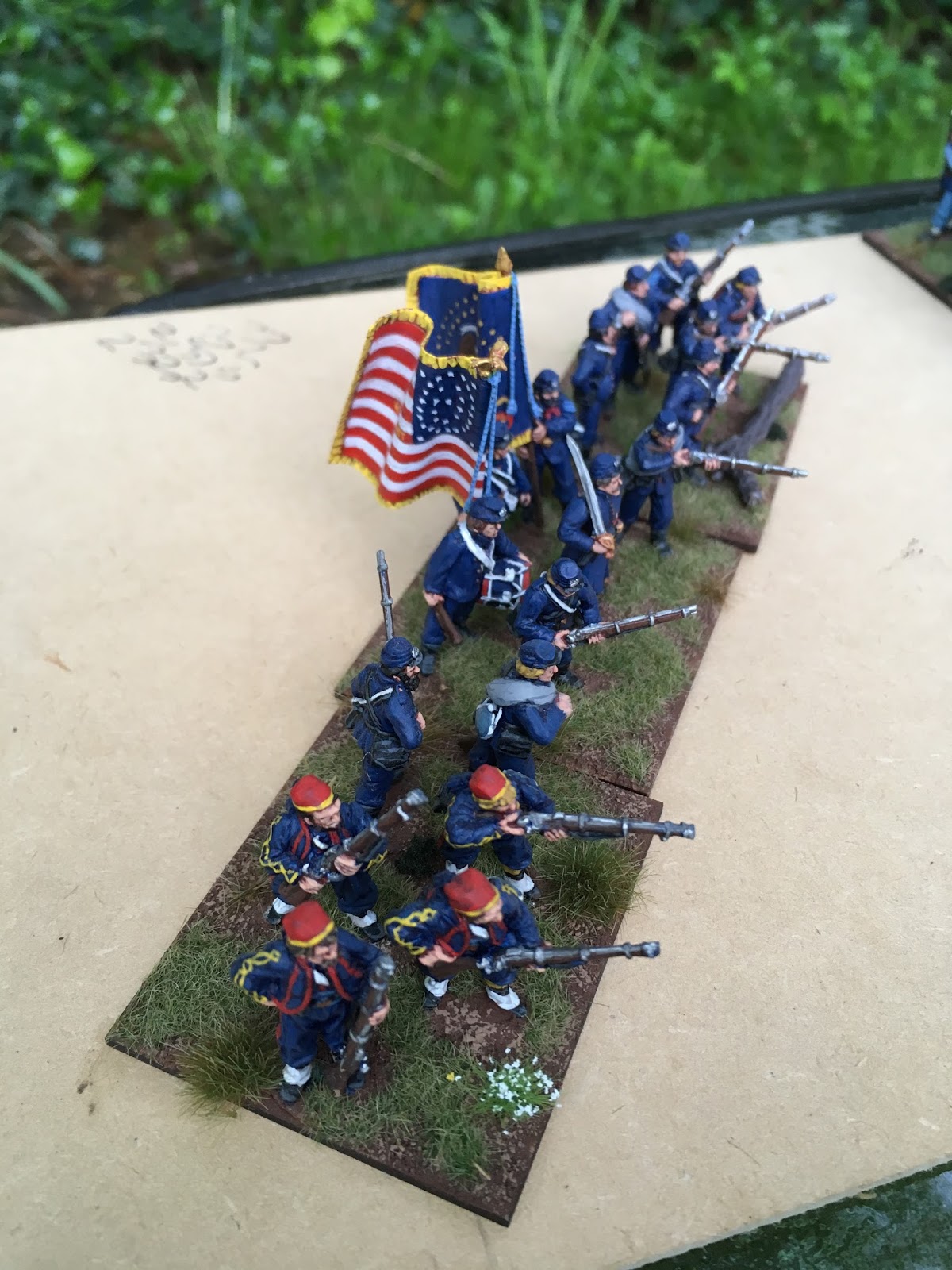
Here's a regiment I've been working on for a very long time, the 20th New York State militia, sometimes called the Ulster Guard.  The men were drawn from the Catskill region, primarily from Ulster County but also from Greene, southern Albany, and eastern Delaware counties.  After war broke out, the regiment was promptly entered into army rolls for a 90-day enlistment.  When the three-months term wore out, the regiment and its sponsors rushed to secure its re-registry under the old number (a matter not only of pride but of financial importance), but in the jumble of regiment-raising, its old spot in the order of precedence was taken by the "Turner Rifles," a German regiment from New York City, and it was redesignated the 80th NYSV.  Officers and men alike were deeply resentful of this change and continued to refer to themselves as the 20th or the Old 20th.


     At Second Bull Run, the 80th (20th) was part of Marsena Patrick's 3rd Brigade, Rufus King's 1st Division of the III Corps under McDowell (Army of Virginia).  King's division, under the temporary command of John Hatch, assisted Porter's assault on Jackson's line.  Patrick's brigade went forward in two lines, with the 23rd and 35th NY in front and the 21st and 80th NY in the rear.  The 80th, trying to press the assault, advanced through a woodlot into an angle between two Confederate regiments, was enfiladed dreadfully, and suffered 279 casualties, including Col. Pratt, who was given a grievous wound, of which he died two weeks later, having been transported to Albany, NY.

I tried to imitate a painting of the regiment by Mark Maritato.
The Ulster Guard (Mark Maritato)

At this stage, the regiment carried a distinctive flag presented by the ladies of Poughkeepsie.  A dozen or so men were killed or wounded carrying the national and regimental colors during the assualt.

The drum is speculative, but the militia company and later the regiment used the Red Hand of Ulster as an emblem in various ways, and I wanted to add a bit of variation.


     The 80th had a distinguished career throughout the rest of the war, most notably at Gettysburg, where it sustained appalling casualties.  The thinned ranks were filled with three years' men from other NY regiments, including the 35th, its old companion from Patrick's brigade, and the regiment mustered out in '66.

It's common to find the graves of men from the 80th (20th) in the Catskill region.  On a personal note, as a child I knew (and was taught to shoot a blackpowder rifle by) a descendant of George Showers, the last surviving veteran from Greene County and a soldier in the 80th, though I didn't know this at the time.

Monday, May 15, 2017

Where Are My Green Flags?*


The next regiment up is the 28th Massachusetts of Farnsworth's brigade.  The 28th was held in reserve of Schurz's division on August 29th and saw little action, despite the battle raging to their front.  On the 30th, however, they partook in the bloody back-and-forth that characterized the Union retreat and lost upwards of 110 killed, wounded, or missing.


At this time, the regiment carried the so-called Pilot Flag and not its later, more famous standard.  The Pilot Flag was difficult to reconstruct, since the few existing images of it are incomplete or somewhat unclear, but I think I got it just about right - apart from the grey blob on the right side, which I learned later should really be an Irish wolfhound.  At the front is Lt. Colonel George Cartwright, wounded during the day's action.

For information on the 28th Massachusetts, I direct all interested parties to the website of the "recreated" regiment, from which I learned much of what I know about the 28th.

*On the Peninsula,  Edwin Sumner, when calling for the Irish Brigade to be sent into action, would ask, "Where are my green flags?", though the 28th would not join the Irish Brigade until late in 1862.  This will likely be my only "Irish" regiment, however, and in any case there were a substantial number of Yankees in the 28th.

Sunday, May 14, 2017

The Grass is Greener

The Bull Run project continues - somewhat haltingly, and slowed by my habit of working on units piecemeal based on funds and availability of desired miniatures.  I've also finally gotten around to basing the soldiers properly; for months I was unable to figure out how to get the "right" green for the grass.  In addition, I was always disappointed by how dull my flags looked - until I realized I had never done the fringes, cords, and tassels. So all that has been adjusted, and there are more units in the works.

In no particular order:

Col. Addison Farnsworth

Brig. General Julius Stahel (converted from a plastic cavalryman)


27th Pennsylvania


41st New York


10th New York


5th New York


Saturday, December 24, 2016

Christmas Tithe

Here's the annual Christmas package for my young relative.  I've never enjoyed painting horses before, but these were fun, especially the Appaloosa.


And a rail fence for him as well.


Friday, December 2, 2016

Good News, Everyone!

It's been hard to find time to work on my projects, hard to find the money for new miniatures, and hard to summon the energy to keep at it.  But I've been chipping away at things steadily.  The real difficulty is that it's been hard to finish units because I don't have enough men for the regimental bases, so there are two nearly-done regiments and two nearly-done command stands.  I was able, however, to complete one brigade-level command base, that of Col. Addison Farnsworth, who led the 3rd brigade, 1st division of Jesse Reno's (IX) corps.  Which means, of course, that his two regiments will follow in due course.  I like to imagine that he's a distant ancestor of that most famous of Farnsworths:


The blue jackets (and colors generally) came out a bit bright in the photos, but I may start switching to a darker blue altogether for some of the regiments to show the variety of shades of blue that would have been found in Union armies.  The dyes used were of better or poorer quality, differed in hue from contractor to contractor, and often turned lighter over time as they were bleached by sun exposure.  The base of course will get more interesting when I eventually have enough change to order the right static grass.


Wednesday, October 19, 2016

Dungeons Deep and Caverns Old

     A big update here to make up for the radio silence of the past months.  This is the entrance to the dwarf-mine my little company of dwarves is trying to reclaim.  I began planning this project probably four years ago but couldn't get myself to stick with it long enough to finish it - until recently, that is, when I decided to discipline myself and complete it.

     I had originally planned to make one 2x4ft. board, only to realize after I'd started that it was too big to fit through the doorways in my house.  I cut it in two, but the cut wasn't as clean as I would have liked, so there is a fairly large seam between the two halves that I'm trying to find a way to conceal.  The first board (the flat, easy one) I finished a while back, long enough ago in fact that it has rather a different feel and a slightly different color from the newer mountain-side (probably dust in the static grass).

Warg-riders chase after the company as it nears its destination (seam partially visible below).

A rear-guard is formed while the sages of the company try to open the gate.

The mesmerizing blue waters of the lake draw the attention of the company's pony.

The dwarves approach the gate, furtively observed by some goblins.

Up the causeway!

The "foyer" which will connect to the next board.

There are a number of additions and slight alterations still to be made: ripples onto the streams, a way to conceal the seam, extra rocks and hillocks, perhaps a dwarf monument.  Also I will need some suitable names for the terrain features.  There are imperfections, in particular regarding the match between old and new boards, but overall I'm quite pleased.  To be frank, I was rather disappointed with myself for not having had the gumption to see this project through, so it feels good to have finished it at long last.

Saturday, August 13, 2016

Birthday Present

I finished these for a young relative of mine who had his birthday a few weeks ago. Federal ordnance rifle and the 11th Mississippi.  He's getting to have a nice little ACW collection now.


Wednesday, July 27, 2016

Goblin Reinforcements


Assorted goblins, including a shaman standing in as the Goblin chieftain.


I tried to give the troll a greenish tint, like it has in the book (the book troll also has toeless feet, but I like the toes too much to get rid of them). Unfortunately, the photos are a bit blue in tone.


I attempted to show the stone floor buckling under the troll's footfall.  Not sure how well it came out.


A bat swarm from Reaper miniatures, flying through the rubble.


This more of less finishes my goblin force.  There may be a few additions in the future, but for now it's done.  Now, to build their stronghold...

Monday, June 6, 2016

National Zouaves


     I present here the 10th New York State Volunteer Infantry, also known as the National Zouaves or, early on, as McChesney's Zouaves.  The 10th was the second regiment in Gouverneur Warren's elite brigade, which had the special distinction of being assigned to Sykes' "Regular" division, otherwise composed exclusively of US Army regiments.  At Second Bull Run, Warren's brigade arrived with Porter's corps and on the 30th remained on the extreme left of the Union line as a precaution.  By mid-afternoon, it had moved to the edge of a field off the western face of Chinn Ridge, with Young's Branch behind it.  Warren ordered six companies of the 10th  into the edge of a woodlot as skirmishers, while the other four remained to the left of their sister regiment.  At about 4PM, the Confederates with whom skirmishers were exchanging fire rose as one man and advanced, heralding the beginning of Longstreet's assault.  The six companies immediately came under heavy fire and, being in skirmish order, had no hope of resisting the advance, so they fell back rapidly and attempted to form up with the four other companies on the 5th's left.  With much of the 10th scattered across a wide front, however, this was no easy task, and the regiment soon came under a withering fire from the 5th Texas off its flank that scotched any chance at putting up organized resistance.  By this time, the 5th NY was buckling, and Warren ordered a withdrawal, which went unheeded but proved unnecessary, since the men soon broke and tried to make it over Young's Branch to safety.  During this action, the 10th got off more lightly than the 5th, presumably because it was a less tempting target; all the same, the National Zouaves suffered 115 casualties, approaching 25% of their strength.


     Here we see Colonel John Bendix, an able soldier and enthusiastic recruiter, trying to call in his skirmishers and form up on the left flank of the 5th NY.  There are only 15 models rather than my usual 18, to signify the absence of the skirmishers who could not rejoin the colors.  The tree on the left represents the scrub growth at the edge of the woodlot where the skirmish line had been posted.


     The matter of the regimental uniform was of great interest to me.  The 10th had three different official uniforms over the course of the war.  The first was a dark blue and red affair with a white havelock, which seems to have proved as unpopular with the National Zouaves as with everyone else and was soon discarded (the havelock, I mean).  In October of '61, the original uniform was replaced and the men issued with a distinctive (and as far as I know unique) color combination of sky-blue pantaloons and middle-brown jackets, along with red trim, fez, sash, and vest.  This uniform was badly worn during the heavy campaigning in the first part of 1862, and a third, fairly standard blue uniform was ordered in September '62 and reached the regiment at an uncertain later date.  So what did the 10th wear at Second Bull Run?  Had the second uniforms been totally (but temporarily) replaced by the standard Union dress? Were the men still wearing their brown uniforms?
     Brian Pohanka's writings on the action at Chinn Ridge state that the 10th was largely in regulation dress, which, since I was looking forward to something more colorful and unusual, was rather a disappointment. (I have always found brown uniforms attractive, perhaps because of all the Austrians I've painted.)  Some additional research yielded pleasing results, however.  Don Troiani's painting of the Texan attack on Chinn Ridge shows a New York casualty in regulation blouse and trousers but with the red fez of the 10th clapped on his head.  A real trove of information came in the form of a photograph (or more correctly the comments about the photograph, since I do not have access to the image proper) taken some time in '62, showing some National Zouaves in the field.  Most of the zouaves wear fatigue blouses or NYS jackets but still wear fezzes, and a few men retain (nearly) complete versions of the brown/blue uniform - in short, a real jumble of clothing that makes for interesting modeling and painting.  Since I had to remove the forage caps from the metal models, I took the opportunity to sculpt fezzes worn in the "skull-cap" fashion we see in many photographs, which some men found better-fitting and more comfortable.