Saturday, June 4, 2016

Grimdark

    A little diversion into the forty-first millennium.

     When I was in high school I was somewhat obsessed with 40k and more specifically the Imperium.  I never gamed or even collected a complete army, but I was fascinated by the art and the setting: the atmopshere of decayed grandeur and the mixture of the arcane, the primitive, and the futuristic.  I will try to avoid the inevitable anti-GW rant, but I will say that the recent emphasis on the epic (big war machines, big battles, etc.) has resulted in a blander, less original "space wars" feeling (which is one of the reasons I drifted almost completely away from 40k in the past three or four years).  In my opinion, the creative torch has passed from the devs and artists of ten years ago to the Inquisimunda community (see The Convertorum and Iron Sleet), who are focused on the narrative and hobby aspects rather than on scale or 'epicness.'  Before my disillusionment, I had tried my hand at this more intimate approach - with enthusiasm but not much gumption.

     While poking around in some boxes I recently rediscovered my trove of 40k bitz and semi-finished I-munda models, mainly of various Imperial citizens and agents.  On a whim I decided to revive this forgotten project and build/paint a few more models.  I've tried to achieve a Blanche-esque color scheme: pale skin and lots of reds and golds, standing out against muted background colors.  The point is to be striking rather than realistic.


Imperial administrator and a mysterious gunslinger.  These were done a few years ago.  The skull might need some touching up.


Cherub


A 40k version of the medieval barber/surgeon.  I imagine he stands around on street corners offering therapeutic bleedings and the like.  


Two henchmen.


Some kind of crusader.  He's going to get a big shield on his left arm, but that will not be attached until it's painted.


     The next batch of Federals should be ready tomorrow - only the State color remains to be painted.  Stay tuned!

Saturday, May 14, 2016

The Greatest Traveller and Huntsman of this Age of the World

     I've had this model of Strider in a drawer for easily five years and never got around to painting him.  It's from the original Fellowship of the Ring set from way back in 2001 - in my opinion these are/were some of the best sculpts in the whole LotR/Hobbit range.


     There is a big controversy, as you may know, about whether Aragorn has a beard, and I decided to take the middle road and give him a heavy growth of stubble not unlike Viggo's in in Fellowship.


     My painting has gravitated towards sharper, bolder highlights in recent years, and so I tried to paint Aragorn in a more realistic and toned-down way, but as usual the overall effect is rather muted.  Still, I am very happy with the finished result.


     Federals on the way, I promise!


Sunday, April 17, 2016

Into Mirkwood


     I've been working on a Mirkwood terrain board for a few months, on and off.  Frequently, artists depict Mirkwood as a tangled, overgrown forest full of gnarled trees and tangled roots.  Here's a still from The Desolation of Smaug.  To my eye, there's nothing interesting about this kind of forest - it's become the 'go-to' forest design for any fantasy setting (Snow White and the Huntsman, e.g.).


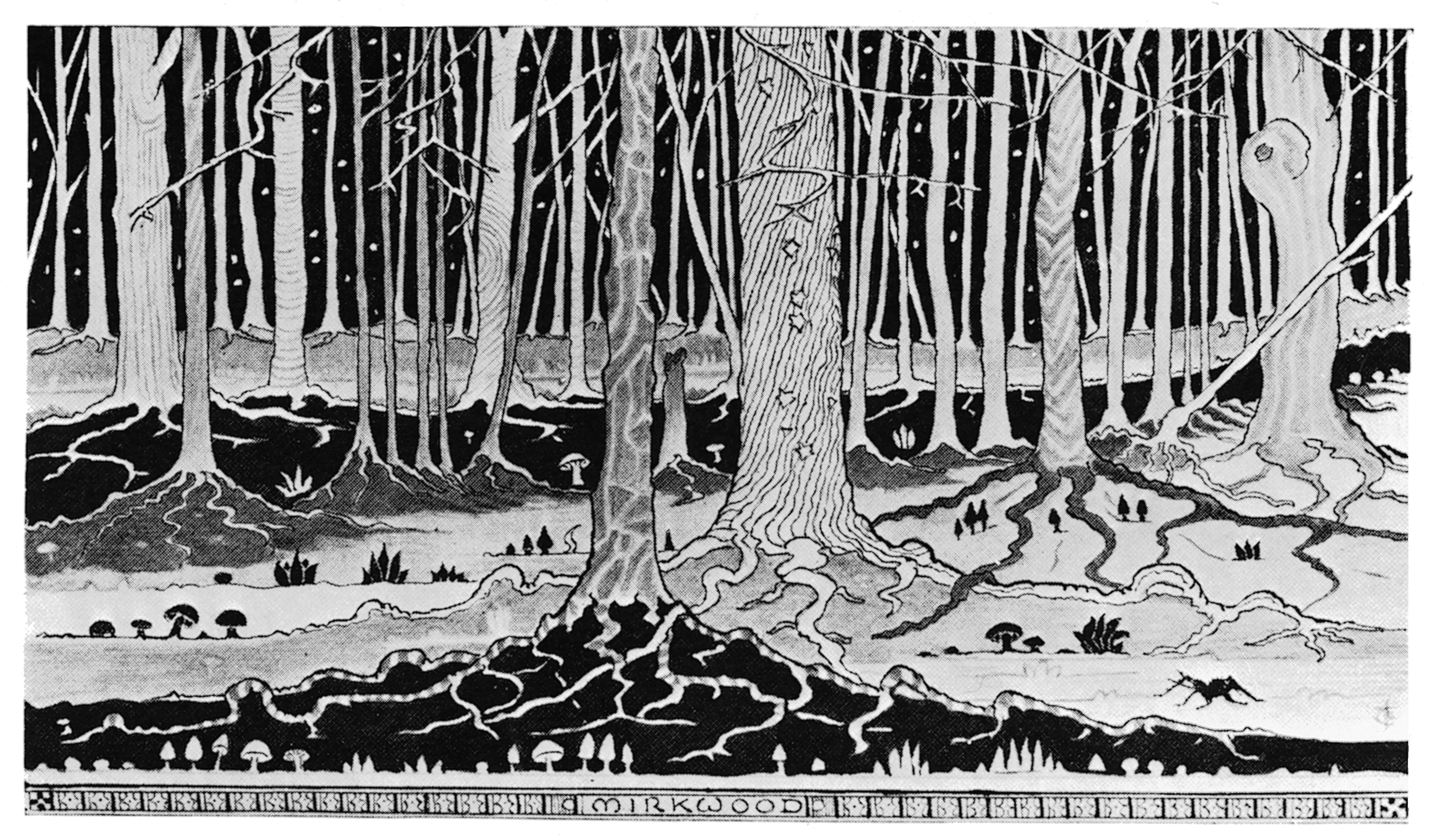
     Tolkien's own drawing of Mirkwood is quite different, however.  Endless rows of fairly uniform trees create a kind of eerie semi-monotony.  What is more, old-growth forests often have little in the way of undergrowth because the trees are tall and the canopy dense enough to block out most of the sunlight, and few branches survive on the lower portions of the trunk. So this is a more life-like representation of an old forest.


     Here is Siegfried in a forest in Fritz Lang's Die Nibelungen.


     And here's a still from Orson Welles' Chimes at Midnight, when Falstaff and his pals waylay some travelers and are in turn set upon by Harry and Poins.


     I find these images much more interesting and affecting.  

     Here's what I've got so far.  The trees are just dowels of different diameters, wrapped in toilet paper soaked in watered-down glue, with roots made of twisted floral wire bound in masking tape.  By varying the colors, textures (from sawdust), and the direction of the TP wrapping, one can create a number of different tree types.  The leaf litter is from JTT, and the mushrooms are from a Polish company called Ristul (I think?).  I intend to make enough to cover the whole table, but these were the trial run.


     Not the best pictures, and the effect is ruined by the bright sunlight in the background, but that's the idea.  Will try to prepare a more scenic backdrop next time.

Tuesday, March 22, 2016

This Hand for My Country

Bit of an odd post today, and one I've been meaning to complete for some time.  In a way it's a lead-up to my next Federal regiment, the 80th (20th) NYSVI.  I will write more about them when the regiment is fully painted. 

At Second Bull Run the 80th was under Colonel George Pratt, who received mortal wounds while leading his men against Jackson's right flank on August 30th.  Pratt was born in what is now Prattsville in Greene County, NY, a town named for his father, Col. Zadock Pratt.  Col. Pratt was many things: tanner, businessman, militia officer, Congressman, reformer, banker, and developer.  One thing he was not, however, was modest.  Not only does Prattsville bear his name, but a large rockface outside of town, now known as Pratt's Rock, is covered with carvings he commissioned to commemorate himself and his family.  George Pratt, a state senator, businessman, militia officer, and amateur historian, moved to Kingston, NY, seat of Ulster County, and subsequently was involved with that county's militia.  After he was killed, he was of course added to Pratt's Rock.


Col. Zadock Pratt: "Tanner, Farmer, Builder, Banker, U.S. Congressman."  Pratt is also responsible for revolutionizing the postal system in the United States.  Previously, postage for letters and packages was paid by the addressee upon receipt of the item.  Transportation was costly, and therefore postage was high, so it was not uncommon for an addressee to refuse a letter upon its delivery, in which case the postal service would have to return it to the sender (and pay for the two-way trip, labor, etc.). Pratt, believing that the high cost discouraged people from corresponding, moved while in Congress for the system to be reformed.  The sender would pay postage prior to mailing, and postage would be kept low.  Since it would be simpler and cheaper to send letters, more people would send them, and a net increase in postage revenue would arise in time; at the same time, increased correspondence would stimulate intellectual and commercial development.  Pratt was so proud of this accomplishment that he ordered it engraved on his tombstone.


His son, Col. Pratt - one of many carvings on Pratt's Rock. 

G. Pratt from the front.


Also carved into the rock is an emblem the militia regiment, the Red Hand of Ulster, encircled by the words "This Hand for My Country," a phrase of Pratt's devising that would become a sort of motto for his regiment.


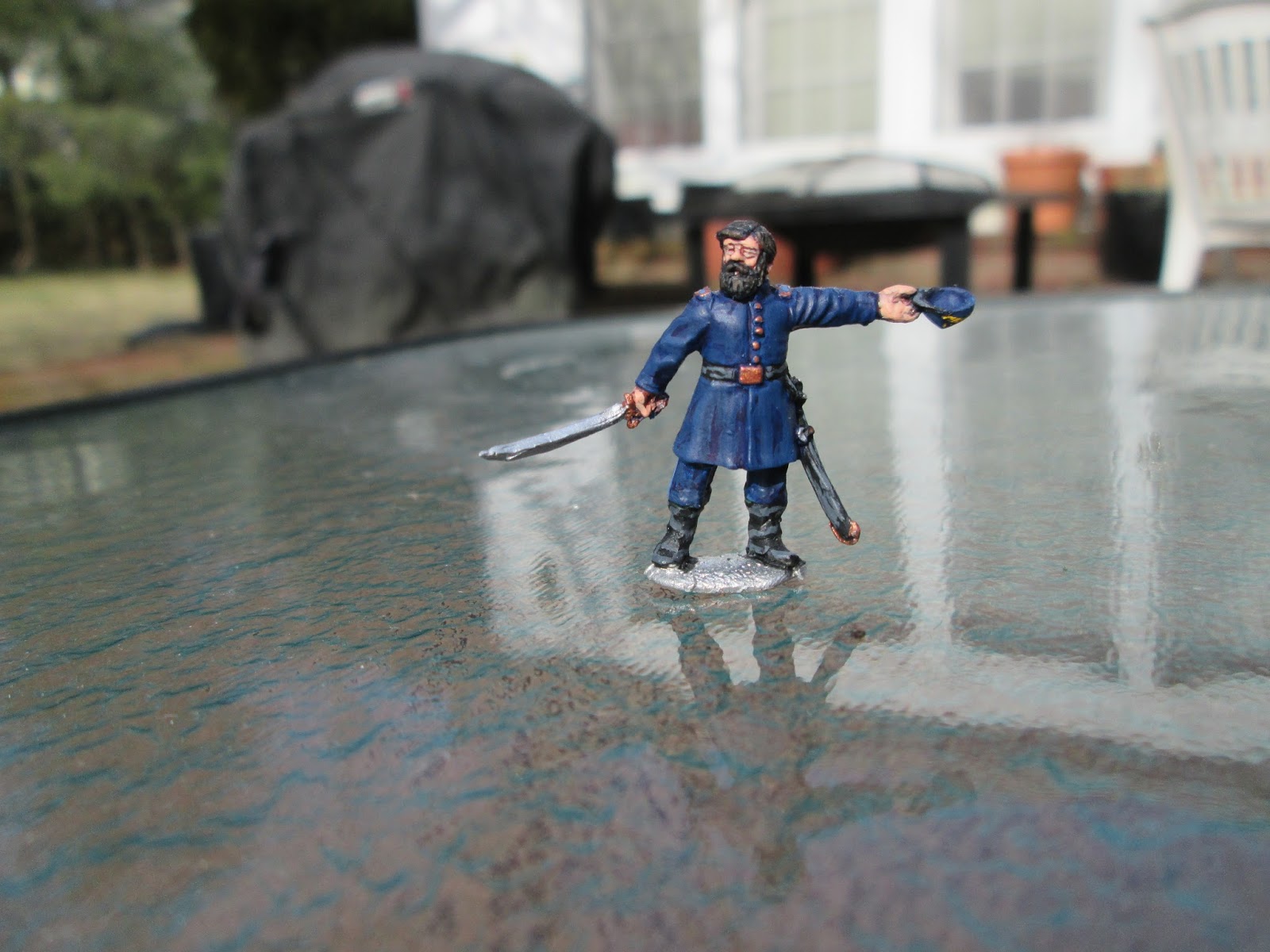
Here is Col. Pratt, urging his men toward the enemy.  The model is a fiddled-with Perry Union officer, who's been given boots, hair and beard, and a hat in his outstretched hand.

Saturday, February 27, 2016

Over the Merlock Mountains...

     So begins "The Mewlips," a curious and tantalizing poem from the oft-ignored Adventures of Tom Bombadil.  The poem describes a set of horrific, flesh-eating creatures that drag their victims into gloomy "cellars" and devour them.  There are many references to geography that, though apparently fictional, could correspond with the regions near the Long Lake. 

     I had two plaguebearer bodies left over from an aborted earlier project, and for a long time I didn't quite know what to do with them.  Something about their awkward limbs and ghastly, bloated bellies stuck in my mind, however, and eventually, it occurred to me that they would serve well as mewlips. 

     The prevailing supposition is that a mewlip is in fact an orc, or rather an orc as it might exist in a nonsensical hobbit poem: a vague, atavistic memory of the orcs that might have preyed on hobbits before they crossed the Misty Mountains, transformed over centuries of story-telling into something like a bogeyman. This is a likely-enough theory.  As I started to fiddle with the plaguebearers, however, I came to think of mewlips rather differently.  One of the bodies had a pair of what might pass for breasts, so I began to think of it as the female.  From there, it was an easy step to see the mewlips as a kind of sub-created version of something from one of Tolkien's dearest real-world stories, Beowulf.  

     There's not much to go on in the poem, but it seems that the mewlips live in caves or grottoes situated in a dreadful swamp or marsh.  These caves contain treasure, presumably filched from the bodies of victims.  The mewlips emerge to seize their victims; they feed; and they keep the victims' bones in a sack. We cannot tell how many mewlips there are - whether they are a proper species or just a small group of monsters, nor do we have much in the way of a physical description.

     The mention of the sack caught my attention.  It seemed like an odd detail, and I couldn't help but think of a line from Beowulf which mentions Grendel carrying a bag or pouch made of dragon-hide into which he stuffs the corpses of men he has killed.  Then there is the swamp itself, a bleak, festering marsh situated far away from the abode of civilized men.  The poem mentions gorcrows roosting in the willows and "gargoyles" staring down at any trespassers.  Whether these gargoyles are actual gargoyles, the mewlips themselves, or perhaps other hideous beasts is unclear.  Here again I was reminded of Beowulf: the otherworldy swamp, overhung with trees and filled with writhing water-monsters.  Below, in the lair of the merewif, Beowulf finds a treasure-hoard.  And there is, of course, the obvious similarity between the mewlips and the monsters themselves.

     Before anyone jumps to conclusions, I should make clear that I am not saying Tolkien intended mewlips to be Grendels.  Rather, there are certain similarities - allusions, even - to Grendel and his mother that, to my mind, are unlikely to have been entirely accidental.  In the same sense, I did not set out to make my own version of Grendel and his mother but rather to allow my fondness for Beowulf to inform my understanding of a what a mewlip is like.

     These figures saw a number of firsts: the first time I've resculpted faces, the first time I've tried to mimic figures standing in water, and the first time I've sculpted genitalia.  It took me a while to decide whether the last part was necessary, but I didn't care for the sexless, empty-crotched look of the plaguebearers.  In addition, the text of Beowulf establishes Grendel and his mother as descendants of Cain, a kind of twisted off-shoot of humanity.  There's also an academic theory that considers the merewif a vestige of the fertility deities that preceded Germanic polytheism.  So there is some scholarly justification for what was primarily an aesthetic decision.


     And the finished products...


     The swamp bases aren't quite what I'd hoped.  Oh well.

Saturday, February 20, 2016

Above Us, Or Around Us

    So read the scroll stitched onto the National Color of the 5th New York Volunteers (Duryee's Zouaves), surely a regiment that needs little introduction.  Already a veteran unit in 1862, they earned their greatest and most terrible honor on the last day of Second Bull Run, when the 525-strong regiment suffered 332 casualties, at least 120 of them fatal, in under 10 minutes.  Suffice it to say that Zouaves fulfilled the oath in their motto.
     There is plenty of information about the 5th on the Internet, but I draw your attention to this article, which describes in vivid detail those lethal ten minutes on August 30th.


       The miniatures are of course from the Perry Zouave set and were a real pleasure to paint.  You may note a few altered weapons - two companies carried Sharps rifles, which I tried (imperfectly) to recreate.


     Here we Sgt. Allison, carrying the National Color, and Sgt. Spelman,carrying the Regimental Color. Allison was an Englishman, Spelman an Irishman. Both were killed carrying the flags of their new nation, as was every other man in the Color Guard but one.
     In between them is Capt. (acting Col.) Cleveland Winslow, a capable but rather unpopular officer who would lead the regiment until his wounding at Cold Harbor.  He was the son of the regiment's chaplain, who accompanied him back to Alexandria on a hospital steamer.  During the voyage, the elder Winslow fell overboard and drowned, and the younger Winslow succumbed to his injuries soon after reaching Alexandria.
     The flags are hand-painted.  I managed to get them in the right size for once - noticeably larger than those of the other regiments I've done. The Zouave set comes with only the spear-point finials for the flag-poles, so I sculpted an eagle for the National Color. Capt. Winslow is actually a Perry Confederate officer. In his "official photo," his sleeves are decorated with Austrian knots - a rarity among Union officers.  Winslow was actually mounted (his horse virtually disintegrated in a hail of bullets, and all other mounted officers were killed), but for purposes of identification, I have decided to keep all regimental officers on foot.


          On the end of the line is Sgt. McDowell, a gigantic ex-fireman who, unwilling to retreat and too injured to reload his weapon, stood in his place and scowled at the approaching rebels until he was shot through the forehead.


      I should have another Federal update soon.

Monday, February 15, 2016

Knight of Evendim

     Another semi-LotRO-inspired project here.

     Every once in a while I like to wander around the shores of Lake Evendim, which is, I think, one of the most beautiful and peaceful regions in the entire game.  For those of you who don't play, there are a number of old Arnorian ruins there, reverently watched over by some Rangers.  I'd been toying with the idea of recreating them in miniature for some years but couldn't quite get myself to start on the project until recently.

     The image on the shield is meant to resemble the view westward across Lake Evendim after the sun has set, with the spire of Tinnudir visible on the right.  Looking at it I am reminded of the shield of King Arthur in Culhwlch and Olwen, which is called Wynebgurthucher, or "Face of Evening."

     The miniature is one of the old Rangers of the North that came out in one of the early SBG supplements.  Very handsome figures, to my mind.  This wound up being perhaps the most complicated conversion I've ever done; I had to cut out and reposition the left forearm, grind off the quiver, and then re-sculpt the cloak.

     There might be a few more of these in the pipeline. We'll see.